Download free Class 3 division worksheet with answers. Contains 24 practice problems covering basic division facts, division with remainders, equal sharing, picture-based division, word problems, and multi-step challenges. This printable PDF includes visual diagrams, step-by-step solutions, and assessment rubrics.
What is Division?
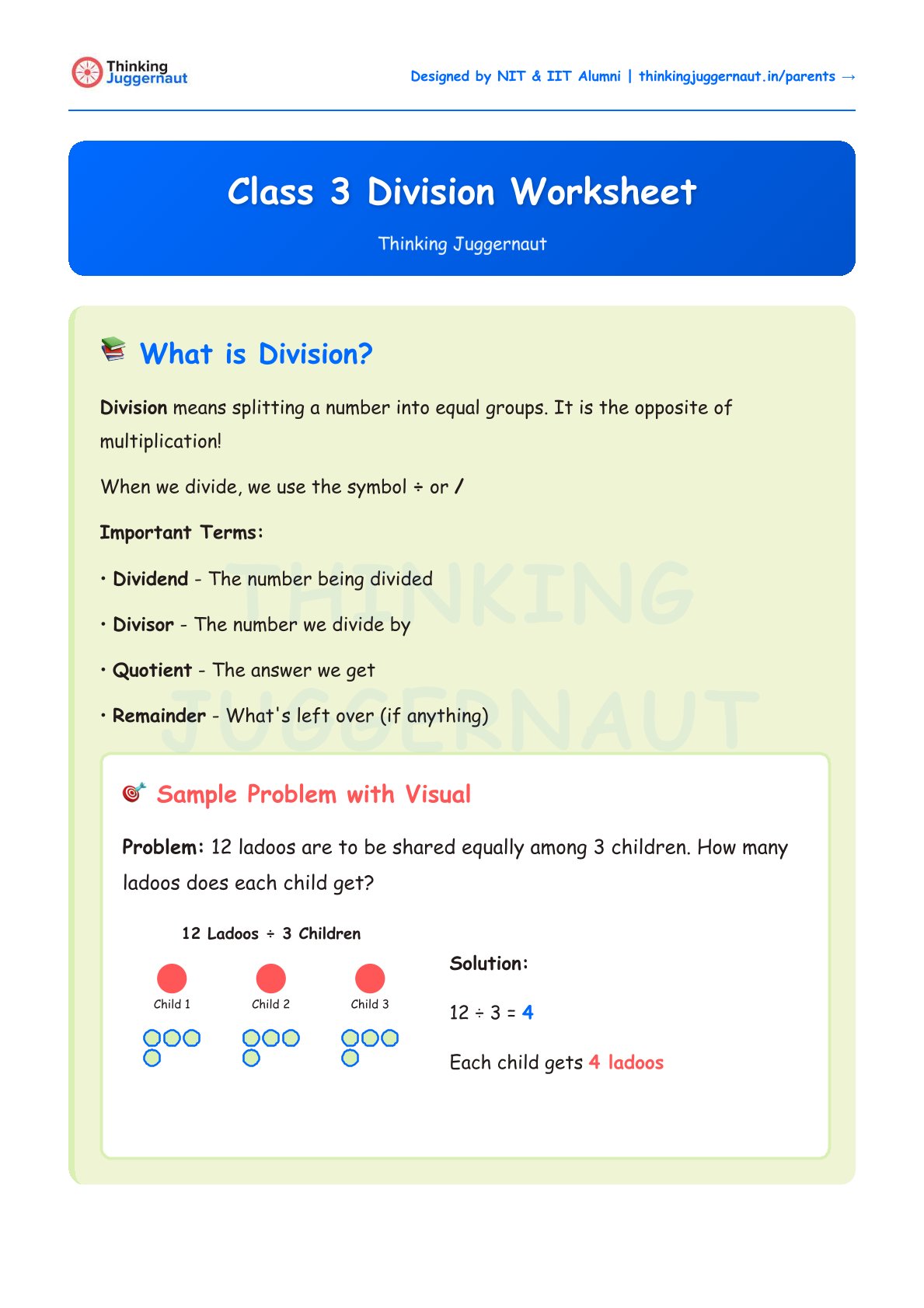
Division means splitting or sharing a number into equal groups. It's the opposite operation of multiplication and one of the four basic math operations.
We use the symbol ÷ or / to show division.
Important Division Terms:
Dividend: The number being divided (the total amount)
Divisor: The number we divide by (how many groups)
Quotient: The answer (items in each group)
Remainder: What's left over when division isn't exact
Example: In 12 ÷ 3 = 4
12 is the dividend
3 is the divisor
4 is the quotient
Division as Equal Sharing:
Division answers the question: "If we share this equally, how much does each group get?"
Example: 15 candies shared equally among 3 friends means 15 ÷ 3 = 5 candies for each friend.
Solved Example: Step by Step
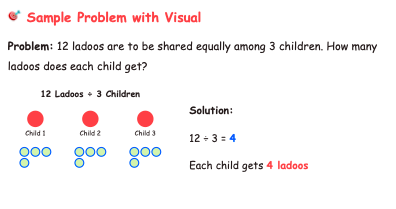
Problem: 12 ladoos are to be shared equally among 3 children. How many ladoos does each child get?
Solution:
Method 1 - Visual Sharing:
Start with 12 ladoos
Give 1 ladoo to each of the 3 children (12 - 3 = 9 left)
Give 1 more to each (9 - 3 = 6 left)
Give 1 more to each (6 - 3 = 3 left)
Give 1 more to each (3 - 3 = 0 left)
Each child got 4 ladoos
Method 2 - Division:
12 ÷ 3 = 4
Answer: Each child gets 4 ladoos.
Worksheet Problem Types
This PDF includes varied question formats:
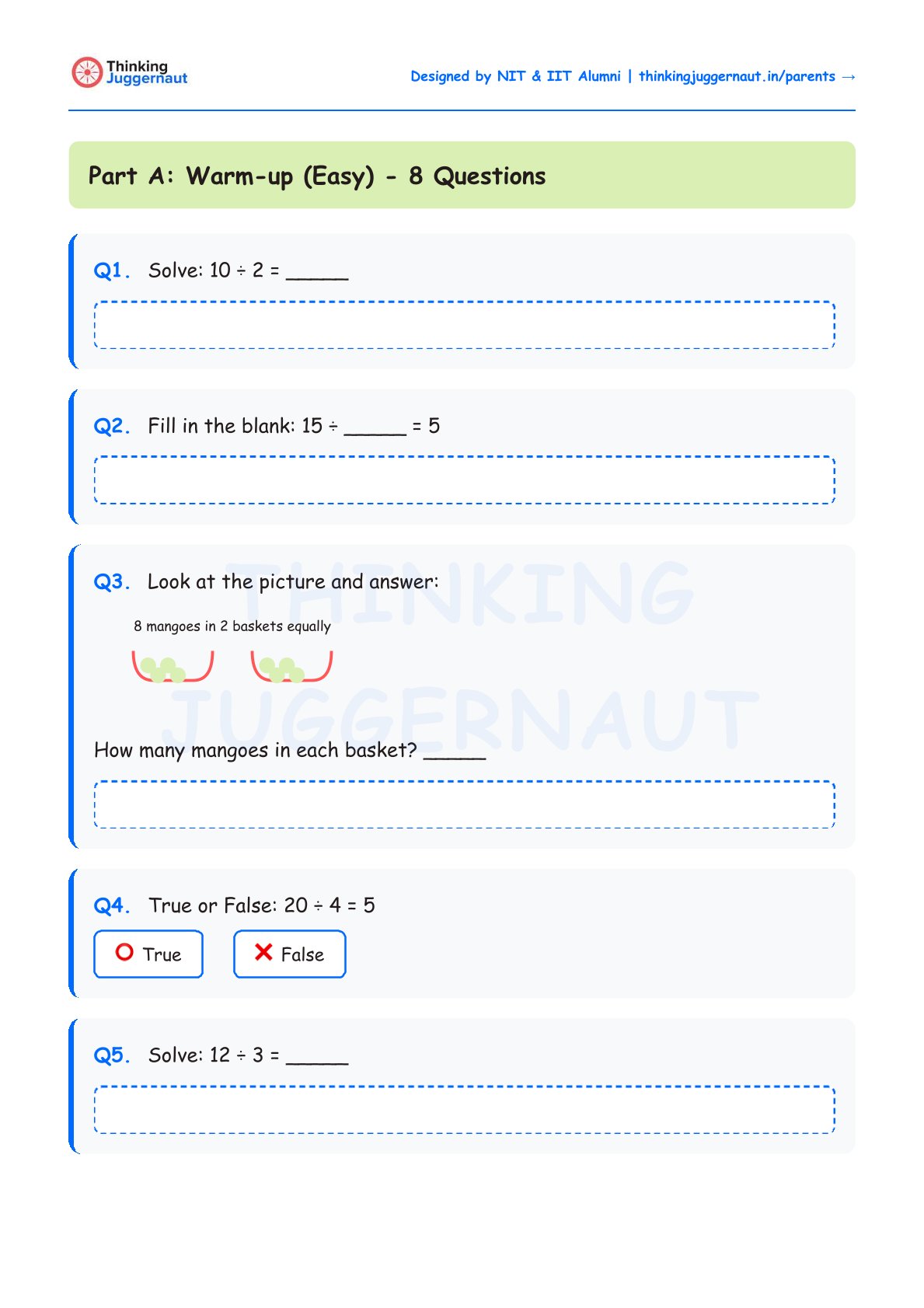
Basic Division: Solve 10 ÷ 2, 12 ÷ 3
Fill in the Blanks: 15 ÷ ___ = 5
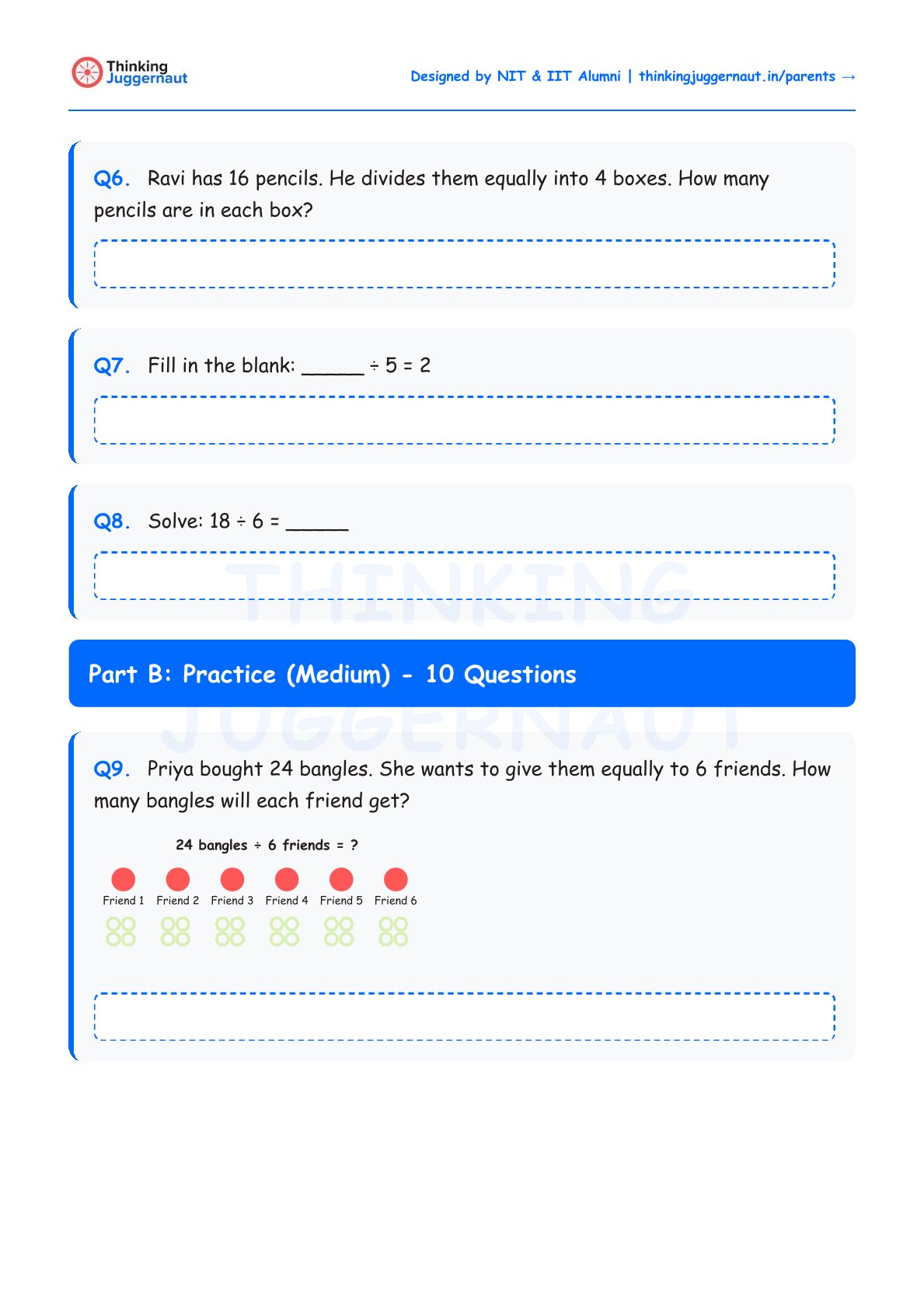
Picture-Based Problems: Visual representation of equal sharing with baskets, fruits, and objects
True/False: Check understanding of division facts
Word Problems: Real-life scenarios with division (sharing pencils, arranging eggs, dividing chocolates)
Division with Remainders: Understanding what happens when division isn't exact (17 ÷ 5)
Matching: Connect division problems with their answers
Multi-Step Problems: Subtract first, then divide (cookie sharing problem)
Common Mistakes & Learning Tips
Frequent Errors to Avoid:
Confusing Division with Subtraction: Division is repeated subtraction, but not the same. 12 ÷ 3 means "how many 3s fit into 12" (answer: 4), not 12 - 3 = 9.
Wrong Order: 12 ÷ 3 is NOT the same as 3 ÷ 12. Order matters in division! Always divide the bigger number by the smaller one in Class 3.
Forgetting Remainders: When 17 ÷ 5, students often write just "3" but forget remainder 2. Always check if there's anything left over.
Dividing by Zero: You cannot divide any number by 0. This is not allowed in math.
Multiplication Connection: Not using multiplication to check answers. If 12 ÷ 3 = 4, then 4 × 3 should equal 12.
5 Essential Tips for Mastery:
Use the Multiplication Table: Division is multiplication backwards! If you know 3 × 4 = 12, then you automatically know 12 ÷ 3 = 4 and 12 ÷ 4 = 3. Strong multiplication tables make division easy.
Draw Pictures: When stuck, draw circles for groups and distribute items one by one. If dividing 15 candies among 3 friends, draw 3 circles and put candies in each circle equally until all 15 are distributed.
Check Your Answer: Always multiply your answer by the divisor to verify. If 20 ÷ 4 = 5, check: 5 × 4 = 20 ✓. This catches most errors.
Practice Equal Sharing Daily: Use real objects - share toys among siblings, distribute fruits, divide stickers. Real-world practice makes division natural and intuitive.
Remember Division Facts: Just like multiplication tables, memorize division facts for numbers 1-10. Quick recall speeds up problem-solving significantly.
Assessment Guide
Total Questions: 24 | Total Marks: 24
Score: 20–24 (Excellent! ⭐⭐⭐)
Division Champion: Complete mastery of division concepts
Next Step: Try multiplication-division mixed problems or Class 4 topics
Score: 15–19 (Very Good! ⭐⭐)
Strong Understanding: Solid grasp of division
Next Step: Practice division with larger numbers and complex word problems
Score: 10–14 (Good Effort! ⭐)
Good Foundation: Basic concepts understood
Next Step: Review division with remainders and practice multiplication tables
Score: Below 10 (Keep Trying! 💪)
Building Skills: More practice needed
Next Step: Focus on equal sharing with objects, review multiplication tables, practice basic division facts daily