Master integers for Class 7 with addition, subtraction, multiplication, and division of positive and negative numbers. Includes solved examples and real-world problems on temperature, profit/loss, and more.
Integers are whole numbers that include positive numbers, negative numbers, and zero. They extend infinitely in both directions: ..., −3, −2, −1, 0, 1, 2, 3, ... Negative numbers appear to the left of zero on a number line, and positive numbers appear to the right. Integers are used whenever we need to represent values that can go in two opposite directions — temperature above and below zero, profit and loss, altitude above and below sea level.
Addition: When two numbers have the same sign, add them and keep that sign. When they have different signs, subtract the smaller from the larger and take the sign of the larger number.
Subtraction: Rewrite subtraction as addition of the opposite number, then follow the addition rules. For example, 5 − 3 becomes 5 + (−3).
Multiplication and Division: If both numbers have the same sign, the result is positive. If the signs are different, the result is negative. This rule applies to both multiplication and division.
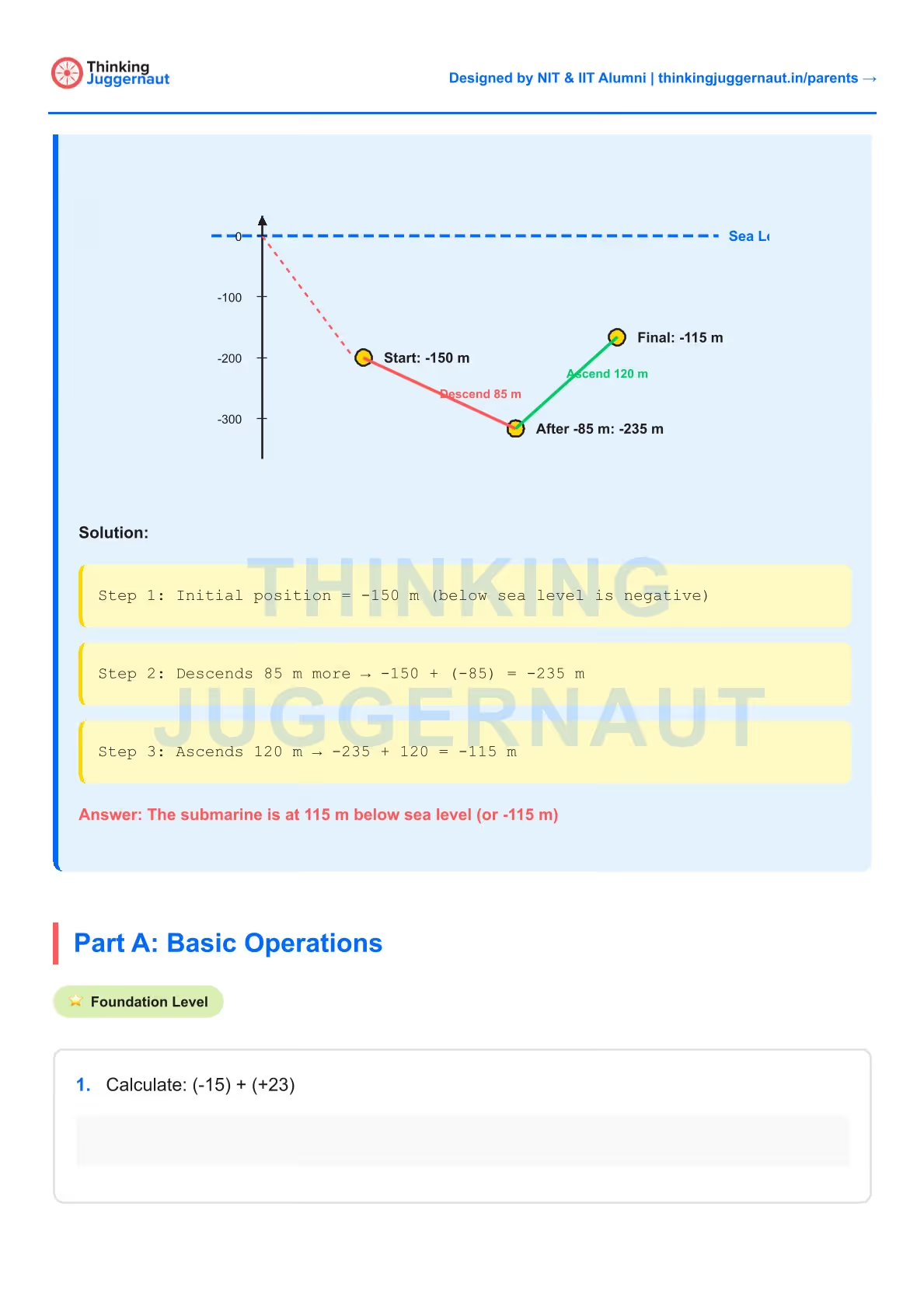
A submarine starts at 150 m below sea level. It descends 85 m further, then ascends 120 m. Find its final position.
The starting position is −150 m, since below sea level is negative. After descending 85 m further: −150 + (−85) = −235 m. After ascending 120 m: −235 + 120 = −115 m.
Answer: The submarine is at 115 m below sea level, or −115 m.
The sign rules for multiplication and division trip up most students. Same signs always give a positive result. Different signs always give a negative result. Memorise this and apply it every time.
Subtracting a negative number is the same as adding a positive. So 5 − (−3) becomes 5 + 3 = 8. Students often get this wrong by subtracting instead.
When adding two negative numbers, do not subtract them. The result becomes more negative. For example, (−5) + (−3) = −8, not −2.
Always write out the signs clearly in your working. Skipping this step is where most calculation errors creep in.
For word problems, assign signs before calculating. Decide which direction is positive and which is negative, then translate the problem into integer operations.
Worksheets build practice. The Applied Maths Project Kit builds understanding — 30 real-world math activities covering the same concepts your child is practising here, from multiplication and grouping to measurement and data.
Designed by IIT & NIT Alumni · NEP-2020 aligned · Trusted by parents across India
Class 7 Algebra
Class 7 Algebraic Expressions
Class 7 Data Handling
Class 7 Fractions and Decimals
Class 7 Geometric Twins
Class 7 Geometry
Class 7 Integers
Class 7 Ratio and Proportion
Not in Class 7?
Visit our Main Math Worksheet Hub to explore all printable worksheets from Class 2 to Class 8.
Almost there!
We will confirm your order on WhatsApp
Order placed!
Thank you! You will receive a WhatsApp confirmation shortly.