Master direct and inverse proportion for Class 8 with a worksheet on multi-step word problems on workers, speed, and provisions. Includes solved examples and real-world applications to build strong problem-solving skills.
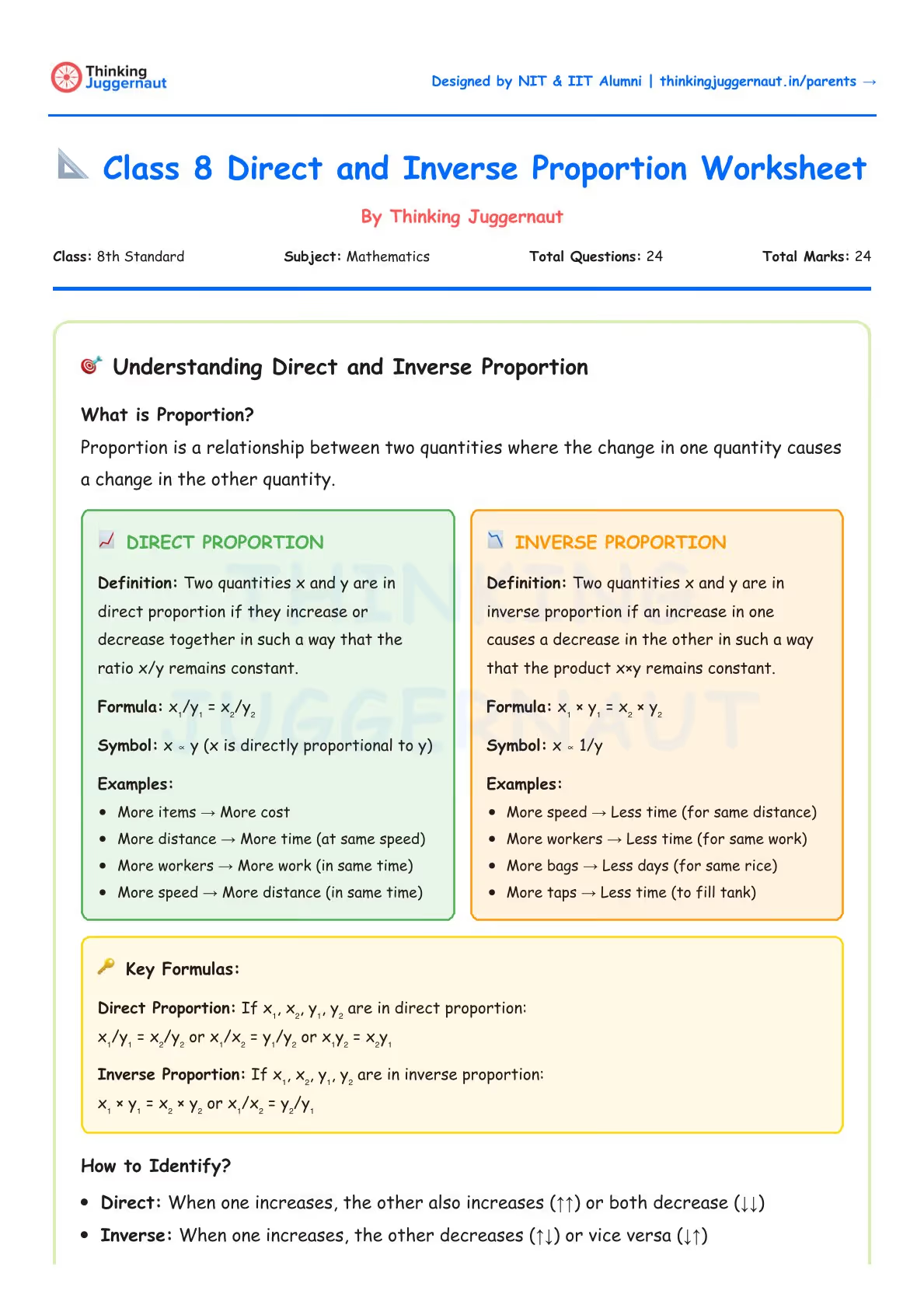
Proportion is a relationship between two quantities where a change in one causes a predictable change in the other. At Class 8, we go beyond simply identifying direct or inverse proportion. We now tackle multi-step problems where conditions change midway — workers joining or leaving, provisions being partially consumed, or speed changing after some time has passed. The critical skill is identifying what stays constant in each problem before setting up the equation.
Two quantities are in direct proportion when they increase or decrease together at the same rate. The ratio between them stays constant. More items means more cost. More time at the same speed means more distance. The formula is x₁/y₁ = x₂/y₂.
Two quantities are in inverse proportion when one increases and the other decreases, such that their product stays constant. More workers means less time to finish the same job. Higher speed means less time to cover the same distance. The formula is x₁ × y₁ = x₂ × y₂.
Ask one question before solving anything: if one quantity increases, does the other increase or decrease? If it increases, the relationship is direct. If it decreases, the relationship is inverse. This single step prevents the majority of errors.
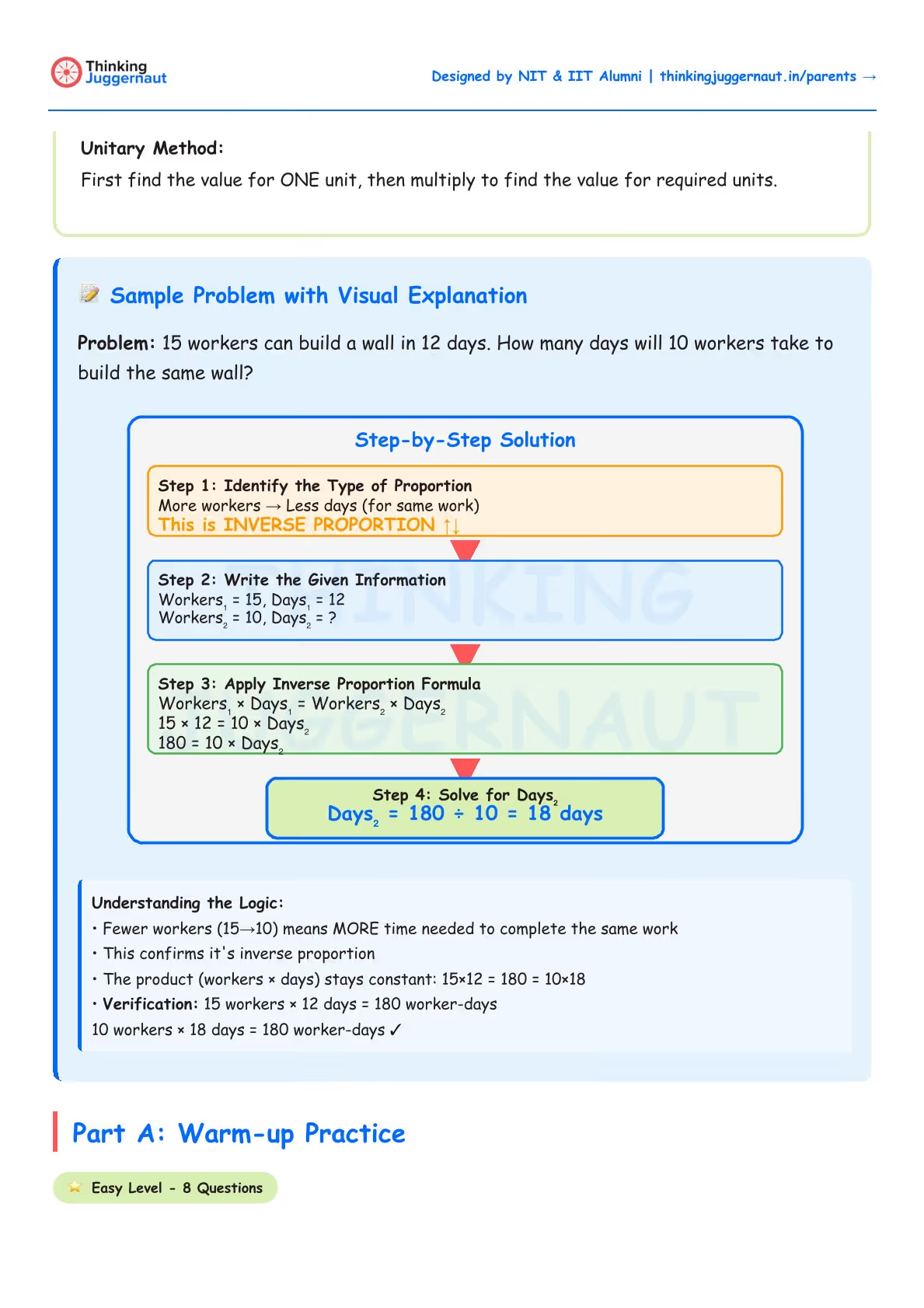
15 workers can build a wall in 12 days. How many days will 10 workers take to build the same wall?
Identify the type of proportion. Fewer workers means more time is needed to complete the same work. This is inverse proportion.
Write down what is known: Workers₁ = 15, Days₁ = 12, Workers₂ = 10, Days₂ = ?
Apply the inverse proportion formula: Workers₁ × Days₁ = Workers₂ × Days₂. Substituting: 15 × 12 = 10 × Days₂. This gives 180 = 10 × Days₂.
Solve: Days₂ = 180 ÷ 10 = 18 days.
Verify the logic: fewer workers (15 → 10) should mean more time needed (12 → 18). The answer makes sense. The product stays constant: 15 × 12 = 180 = 10 × 18.
Answer: 10 workers will take 18 days.
Always identify the type of proportion before writing any equation. Using the direct proportion formula on an inverse problem — or vice versa — gives the completely wrong answer. The one question to ask is: if one quantity goes up, does the other go up or down?
In multi-step problems where workers leave or join midway, calculate the remaining work first. Convert everything into worker-days or student-days before applying the proportion formula. Jumping straight to the formula without this step is where most mistakes happen.
Identify what stays constant in each problem. In a workers-and-days problem, the total work stays constant. In a speed-and-time problem, the distance stays constant. In a provisions problem, the total food stays constant. Building the equation around this constant is the key.
Always check whether the answer is reasonable. If you get more time with more workers, or a negative number of days, something has gone wrong. A quick logic check at the end catches errors that arithmetic alone cannot.
In problems involving three variables — such as workers, hours per day, and number of days — convert everything into a single unit like worker-hours first. Then apply the proportion. Trying to handle three variables at once without this step leads to confusion.
When using the unitary method for direct proportion, find the value for one unit first, then multiply. Skipping the intermediate step and trying to jump directly to the final answer increases the chance of calculation errors.
Worksheets build practice. The Applied Maths Project Kit builds understanding — 30 real-world math activities covering the same concepts your child is practising here, from multiplication and grouping to measurement and data.

Designed by IIT & NIT Alumni · NEP-2020 aligned · Trusted by parents across India
Class 8 Algebraic Expressions
Class 8 Direct and Inverse Proportion
Class 8 Exponents and Powers
Class 8 Factorisation
Class 8 Mensuration
Class 8 Rational Numbers
Not in Class 8?
Visit our Main Math Worksheet Hub to explore all printable worksheets from Class 2 to Class 8.
Almost there!
We will confirm your order on WhatsApp
Order placed!
Thank you! You will receive a WhatsApp confirmation shortly.