Master all 7 laws of exponents with this Class 8 worksheet. 24 problems covering powers, negative exponents, standard form, and real-world applications with step-by-step solutions.
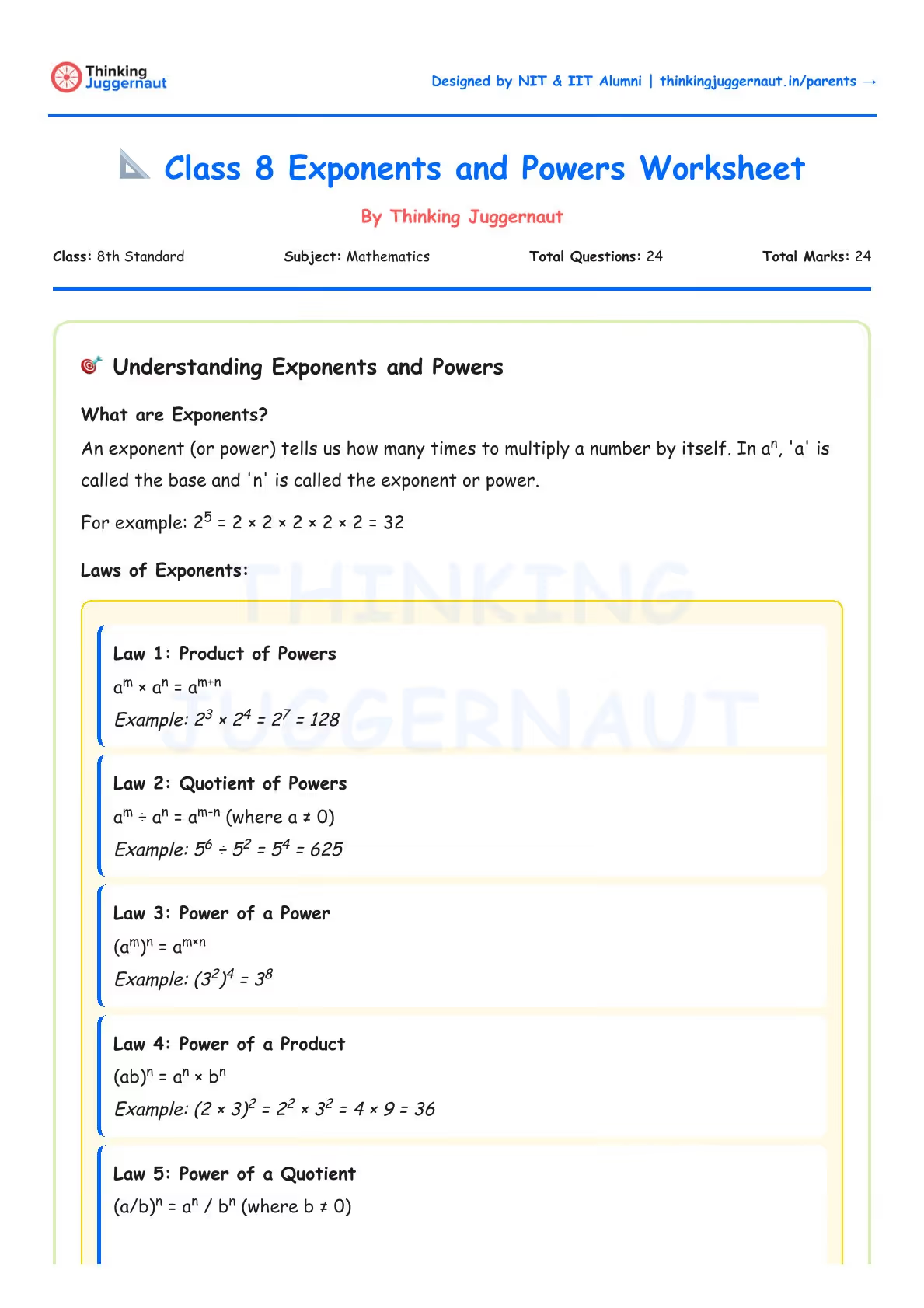
An exponent (or power) tells us how many times to multiply a number by itself. In aⁿ, 'a' is called the base and 'n' is called the exponent or power.
For example: 2⁵ = 2 × 2 × 2 × 2 × 2 = 32
Law 1 - Product of Powers: aᵐ × aⁿ = aᵐ⁺ⁿ
Law 2 - Quotient of Powers: aᵐ ÷ aⁿ = aᵐ⁻ⁿ (where a ≠ 0)
Law 3 - Power of a Power: (aᵐ)ⁿ = aᵐˣⁿ
Law 4 - Power of a Product: (ab)ⁿ = aⁿ × bⁿ
Law 5 - Power of a Quotient: (a/b)ⁿ = aⁿ / bⁿ (where b ≠ 0)
Law 6 - Zero Exponent: a⁰ = 1 (where a ≠ 0)
Law 7 - Negative Exponent: a⁻ⁿ = 1/aⁿ (where a ≠ 0)
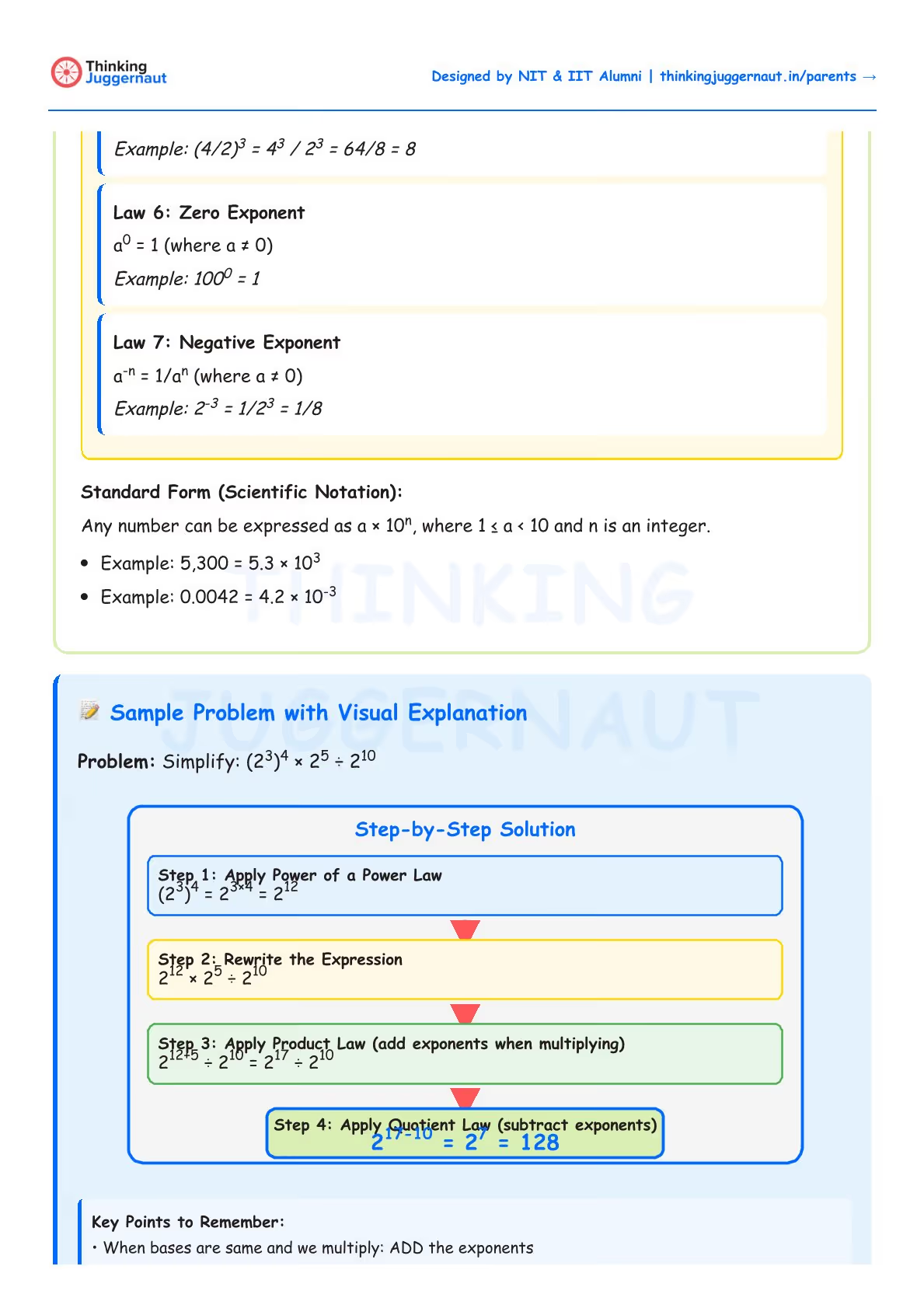
Any number can be expressed as a × 10ⁿ, where 1 ≤ a < 10 and n is an integer.
Example: 5,300 = 5.3 × 10³
Example: 0.0042 = 4.2 × 10⁻³
Problem: Simplify: (2³)⁴ × 2⁵ ÷ 2¹⁰
Solution:
Step 1: Apply Power of a Power Law → (2³)⁴ = 2¹²
Step 2: Rewrite the Expression → 2¹² × 2⁵ ÷ 2¹⁰
Step 3: Apply Product Law → 2¹⁷ ÷ 2¹⁰
Step 4: Apply Quotient Law → 2⁷ = 128
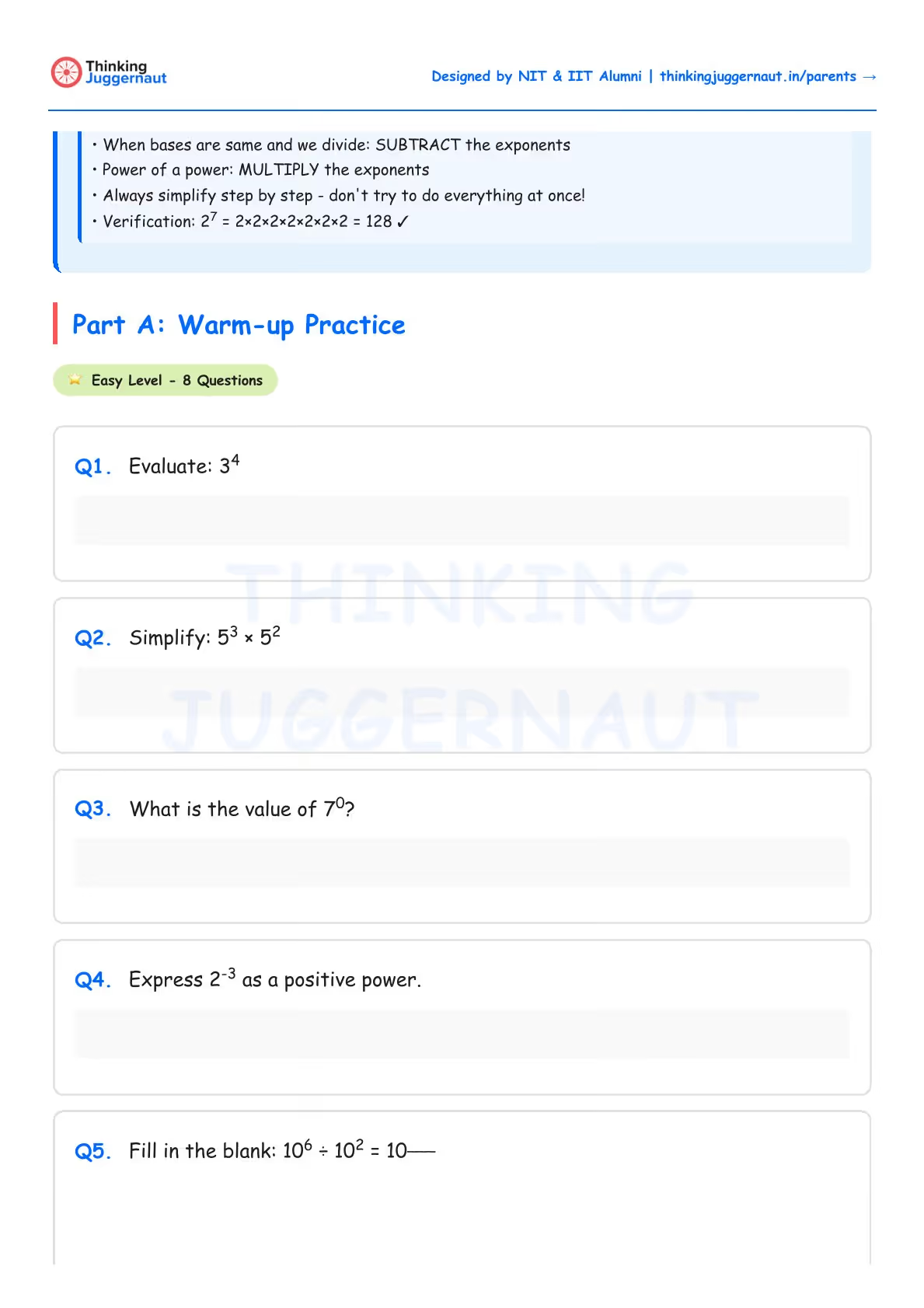
Key Points: When bases are same and we multiply, ADD the exponents. When we divide, SUBTRACT the exponents. Power of a power, MULTIPLY the exponents.
Evaluate: 3⁴
Simplify: 5³ × 5²
Simplify: (3⁴ × 3⁵) ÷ 3⁶
Express 0.000025 in standard form.
Find the value of x: 2ˣ = 128
A bacteria culture doubles every hour. If there are 2³ bacteria initially, how many will there be after 4 hours?
Simplify: [(2³)² × 2⁵] ÷ [(2⁴)³]
If 3ˣ⁺² = 243, find the value of x.
The speed of light is 3 × 10⁸ m/s. The distance from Earth to the Sun is 1.5 × 10¹¹ m. How long does light take to reach Earth from the Sun?
20-24 correct: Excellent! Outstanding! Move on to advanced topics like exponential equations, logarithms, and exponential growth/decay problems.
15-19 correct: Very Good! Great work! Practice more problems with negative exponents and standard form. Focus on complex expressions with multiple operations.
10-14 correct: Good Effort! Keep practicing! Memorize all seven laws of exponents. Practice 15 problems daily focusing on one law at a time.
0-9 correct: Keep Trying! Review the concept section carefully. Start with basic evaluation, then learn one law at a time.
Create a law chart: Write all 7 laws with examples on a single reference sheet
BODMAS matters: In complex expressions, solve brackets first, then powers
Negative exponents: Remember a⁻ⁿ means "flip and make positive" = 1/aⁿ
Standard form trick: Count decimal moves - right moves give negative powers, left moves give positive
Same base rule: You can only add/subtract exponents when bases are identical
Verify answers: For small numbers, calculate the actual value to check your work
Confusing 2³ with 2 × 3 (2³ = 8, not 6!)
Adding exponents when multiplying different bases
Thinking (a + b)² = a² + b²
Forgetting that (-2)⁴ = 16 but -2⁴ = -16 (brackets matter!)
Confusing power of a power with product of powers
Writing 0⁰ = 1 (this is undefined, not 1)
In standard form, using values less than 1 or ≥ 10 for the coefficient
Forgetting to change the sign when converting negative exponents
Worksheets build practice. The Applied Maths Project Kit builds understanding — 30 real-world math activities covering the same concepts your child is practising here, from multiplication and grouping to measurement and data.

Designed by IIT & NIT Alumni · NEP-2020 aligned · Trusted by parents across India
Class 8 Algebraic Expressions
Class 8 Direct and Inverse Proportion
Class 8 Exponents and Powers
Class 8 Factorisation
Class 8 Mensuration
Class 8 Rational Numbers
Not in Class 8?
Visit our Main Math Worksheet Hub to explore all printable worksheets from Class 2 to Class 8.
Almost there!
We will confirm your order on WhatsApp
Order placed!
Thank you! You will receive a WhatsApp confirmation shortly.